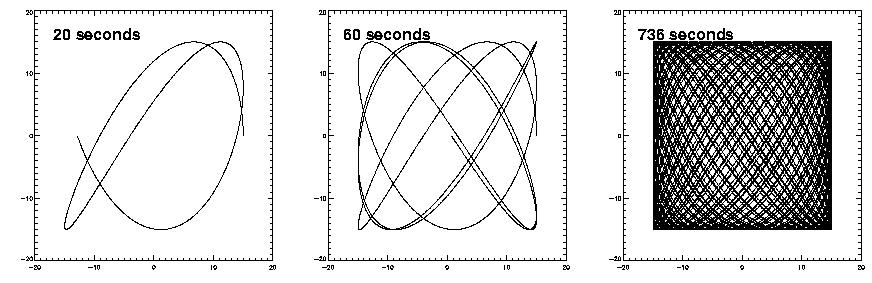
Here we show the progress of the scan at 3 different times.
Sample Lissajous commands
We tend to always use 10 minute integration times for lissajous scans. The UIP command and format is:
SWEEP AX TX /Y AY TY [/alt,/equ]
| Size of uniform coverage (arcseconds) |
Size of uniform area in units of # of 9" beams |
UIP Command |
Comment |
|||
| 115x38 | 13x4 |
SWEEP 20 20 /Y 10 14.142 | Our standard scan | |||
| 77x29 | 8x3 |
SWEEP 38.8 20 /Y 14.6 14.142 | Sweeps over 1/2 of the array | |||
| 38x14 | 4x2 |
SWEEP 58.2 20 /Y 21.8 14.142 | Sweeps over 2/3 of the array | |||
| ** Sensitivity for the uniform coverage area is around 1Jy/sqrt(s) per beam |
||||||
The scan can be done in the alt-az or ra-dec coordinate frames (/altaz or /equ in UIP).
Designing your own scan
We strongly recommend that you use one of the above example scans. However, Lissajous scans are much easier to design than box-scans, provided one follows these simple guidelines:- You should use a ratio of periods that is an irrational number. We typically use sqrt(2)=1.414.
- The area of uniform coverage decreases as the scan amplitude increases.
For example, assume you are doing an azimuthal scan. The SHARC-II long axis is 2', and aligned with azimuth. If
the AX amplitude is 20", then the width of uniform coverage is 2' - 2*20" = 1.3'
- When setting the amplitudes, keep in mind that the array is a rectangle, and roughly twice as wide as it is high.
It is also worth thinking of the amplitude in units of pizel size (4.9").
- The amplitude and period for a given direction should be such that you don't scan too fast and smear the beam.
- Unless you use VERY long periods, the integration time should be 10 minutes per scan. Consult us if you want to
a scan that is much different from any of the example ones listed in the table above.